
ECO4 Warm Home Discount Eligibility Explained
A Warm Home Discount can be more than help with a winter electricity bill. For some households, eco4 warm home discount eligibility may also open the door to fully funded improvements that make a cold, costly-to-heat home cheaper and more comfortable to live in. The key is understanding that the discount and ECO4 are separate schemes, while Warm Home Discount status can be one way to show that your household may qualify for support.
If your boiler is old, your heating is unreliable or your home loses heat quickly, it is worth checking. You do not need to work through the rules alone. A free eligibility check and property assessment can establish what support may be available and whether the measures would suit your home.
What does ECO4 Warm Home Discount eligibility mean?
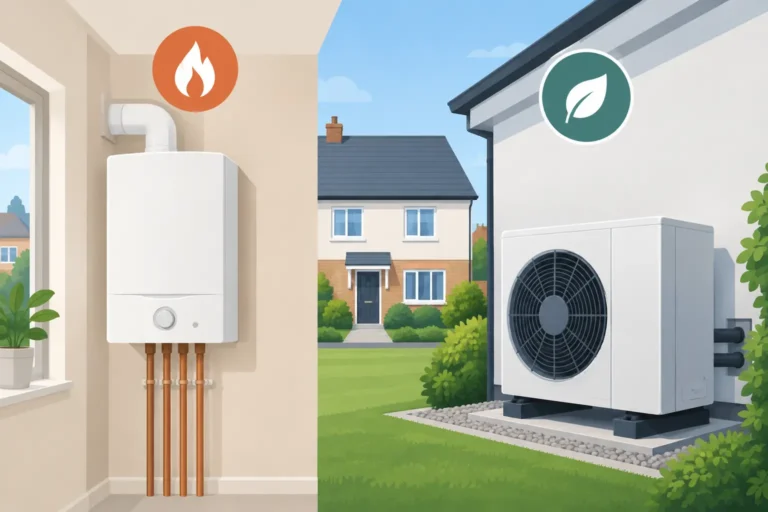
ECO4 was a government-backed energy-efficiency scheme designed to help lower-income households and homes with poor energy performance. It has funded measures such as replacement heating systems, first-time central heating, insulation and air source heat pumps, depending on the property and funding criteria.
The Warm Home Discount is a separate government scheme that provides eligible households with a credit towards their electricity bill. Being in the Warm Home Discount Core Group, or meeting the relevant criteria for a rebate, may support an ECO4 application. It does not automatically guarantee an ECO4-funded installation, because the home itself must also be suitable and the available funding route must apply.
That distinction matters. A household could receive the Warm Home Discount but be unable to have a particular measure installed because of the property type, its energy rating or existing heating. Equally, a household that does not receive the discount might qualify for ECO4 through another qualifying benefit or a local authority route.
Who may qualify for ECO4 support?
Eligibility is assessed on your household circumstances and your property. In many cases, applicants need to receive an eligible means-tested benefit or satisfy local authority eligibility criteria, often known as ECO4 Flex. Warm Home Discount eligibility can be relevant where it demonstrates that the household meets the scheme’s income and energy-cost conditions.
Common circumstances that may support an application include receiving Universal Credit, Pension Credit, income-related Employment and Support Allowance, income-based Jobseeker’s Allowance, Income Support, Child Benefit within certain income thresholds, or other qualifying benefits. Rules and evidence requirements can change, so it is best to have your current award information checked rather than relying on an old list found online.
Private tenants can be eligible as well as homeowners. If you rent your home, your landlord will usually need to give permission before improvements are installed. This is a normal part of the process, and support can be provided with the information they need.
Your home must usually need improvement
ECO4 focuses on homes that are expensive to heat and likely to benefit from energy-efficiency work. Properties with a lower Energy Performance Certificate rating have commonly been the priority. A home’s EPC is useful, but it is not the only consideration. The assessment also looks at the age and condition of your heating, insulation levels, construction type and what can be installed safely.
For example, a solid-wall home with little insulation and an old non-condensing boiler may have several possible improvements. A newer home with efficient heating and good insulation may not need a funded measure, even if the household receives a qualifying benefit.
Which upgrades could be fully funded?
The best measure is not always a new boiler. A boiler works harder when heat escapes through a loft, walls or gaps in the building fabric. For that reason, ECO4 assessments often consider insulation first, or alongside heating improvements, to achieve a meaningful reduction in energy use.
Subject to eligibility and a suitable assessment, funding may cover:
- first-time central heating for homes without a fixed central heating system;
- replacement of an inefficient, non-condensing boiler;
- central heating controls and heating-system improvements;
- air source heat pump installations where the property is appropriate; and
- loft, cavity wall, internal wall or solid wall insulation.
The exact package depends on your home. An air source heat pump, for instance, can be an excellent low-carbon option, but it needs a suitable property and a well-planned installation. In another home, insulation and improved heating controls may make the immediate difference to warmth and bills. A proper assessment avoids promising an upgrade that is not right for your property.
The evidence you may need
Applying should not feel like taking on another full-time job. You may be asked for basic details such as your address, contact information, benefit status and proof of entitlement. If you are a tenant, landlord consent may also be needed.
There may be further checks to confirm the property’s EPC rating, heating type and condition. The installer or grant-support provider will normally arrange a survey to review these points. This is where potential measures are confirmed, rather than guessed at over the phone.
Keep any benefit letters or recent award notices available, but do not worry if you are unsure what counts as proof. Vellurex can help check your circumstances, explain the evidence required and handle your ECO4 paperwork as the application progresses.
A simple route from check to installation
Most households want a clear answer to three questions: Can I qualify? What could my home receive? What do I need to do? The process is designed to answer these in order.
First comes the free eligibility check. This confirms whether your benefits, Warm Home Discount position or local authority route could make you eligible. It is also a chance to discuss your current heating problems, such as rooms that never warm up, high gas use or a boiler that regularly breaks down.
Next is a free property assessment. An assessor reviews how the home is heated, where heat is being lost and which measures may deliver the strongest improvement. This protects you from receiving a one-size-fits-all recommendation.
Finally, once the funding and proposed works are approved, installation can be coordinated. Timescales vary because approval, surveys, property access and the type of measure all matter. However, having one team guide the paperwork and practical arrangements can make the experience far less stressful.
Important timing and scheme availability
ECO4 was scheduled to run until 31 March 2026, so availability after that date depends on the current replacement schemes, local funding and any live obligations available to installers. If you are reading this after the scheme end date, do not assume that an old ECO4 advert means funding is still open on the same terms.
A current eligibility check is the safest approach. It confirms whether there is a live route for your household, rather than raising expectations based on expired information. If funding is available, acting promptly can help you move from an inefficient home to practical improvements without paying the full cost upfront.
A colder home should not mean choosing between comfort and an unaffordable bill. If you receive the Warm Home Discount, have qualifying benefits or live in a hard-to-heat property, ask for a free check and find out what support may still be available for your home.





8 Comments